ArtonLabs colleagues, building a machine learning model with high accuracy in a notebook is only half the journey. The real challenge arises when that model is already serving users every day, while data in the real world keeps changing without waiting for anyone. Many teams feel the work is done once the model goes into production, when in fact that is precisely the point where its quality begins to be tested. This article discusses how to keep a model relevant after release, from recognizing the symptoms of performance degradation to designing a tidy retraining cycle.
To make the discussion easier to follow, here is a table of contents you can jump to directly as needed:
- Why a model that was once accurate can slowly drift
- Data drift and concept drift: two shifts that must be monitored
- Which metrics are worth monitoring in production
- Designing retraining without disrupting the service
- Maintaining data and feature quality along the way
Why a Model That Was Once Accurate Can Slowly Drift
A model is essentially a summary of the patterns present in the training data. When patterns in the real world shift, that summary slowly loses its connection to reality. User behavior changes, seasons turn, prices rise and fall, and new customer segments appear that were never seen during training. The model is not "broken" in a technical sense, but its predictions miss more and more often.
The problem is that this decline rarely appears suddenly. It resembles a seep: small at first, then accumulating into wrong business decisions. That is why continuous monitoring is far more important than a single large evaluation at launch.
Data Drift and Concept Drift: Two Shifts That Must Be Monitored
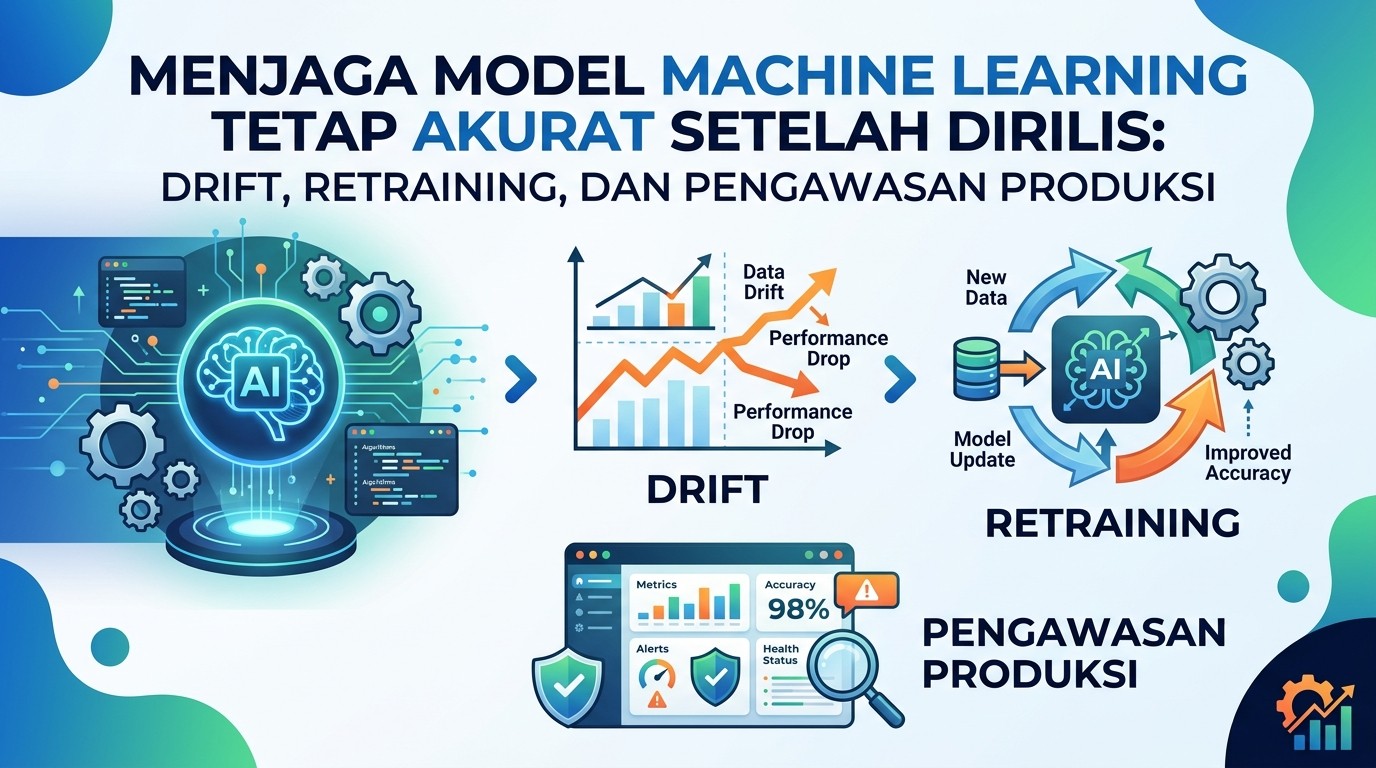
In practice, these shifts can be separated into two types. Data drift occurs when the distribution of input features changes, for example a composition of new users that differs greatly from the old data. Concept drift occurs when the relationship between features and the target changes, for example purchasing patterns that shift due to new habits in the market.
Distinguishing the two is important because the solutions differ. Data drift is often sufficiently addressed by updating the training data, whereas concept drift demands a model or features that are truly rethought. Without clear monitoring, teams can spend time fixing the wrong thing.
Which Metrics Are Worth Monitoring in Production
Accuracy figures alone are not enough, especially since the actual labels often only become available later. It is better to monitor several layers of metrics at once:
- Technical metrics: prediction latency, request failure rates, and compute resource usage.
- Data distribution metrics: changes in feature statistics over time to detect data drift earlier.
- Model quality metrics: precision, recall, or relevant business metrics once labels are available.
- Operational metrics: prediction volume, score distribution, and the proportion of outputs that fall into unusual categories.
This combination provides a complete picture: not only "is the model correct", but also "is the model still being used under healthy conditions".
Designing Retraining Without Disrupting the Service
Retraining can be run on a scheduled basis or triggered by events. The scheduled approach is simple and easy to audit, for example refreshing the model every certain period. The trigger-based approach is more responsive: retraining is run only when a drift threshold or metric degradation is exceeded.
Equally important is the release process. Use shadow testing, gradual rollout, and the ability to roll back to a previous version if performance actually worsens. Each model version should be recorded completely, from the training data and configuration to its evaluation results, so that decisions can be accounted for.
Maintaining Data and Feature Quality Along the Way
No matter how good the algorithm is, it will be limited by data quality. Schema validation, missing value checks, and anomaly detection in the data pipeline should run automatically. Features that were once informative can become noisy, while new features may need to be added.
This is where approaches such as a feature store and data versioning help maintain consistency between the training and production stages. Without that consistency, a model can look great during testing yet languish when serving real requests.
ArtonLabs colleagues, maintaining a machine learning model is continuous work, not a one-off project. By monitoring drift, caring for data, and designing safe retraining, you can ensure the model keeps delivering real value long after launch day. Thank you for reading to the end; if you have questions about this topic or would like to discuss further, please reach out to us through the contact page. We are happy to help.