ArtonLabs colleagues, machine learning is no longer a luxury reserved for a handful of giant technology companies. It has spread to shopping recommendation systems, spam filters, transaction fraud detection, and even predictive maintenance for machines on factory floors. Unfortunately, there is a fairly wide gap between a model that looks sophisticated in a notebook and a model that is genuinely useful in the field. Many projects stop at the experimental stage because they are considered "done" once the accuracy is good, even though the real challenge only begins when the model has to serve thousands of requests every day. This article discusses how to bring machine learning from mere experimentation to a reliable and trustworthy service.
To keep our journey more focused, here is a roadmap of the discussion we will explore together:
- From Notebook to Production: Critical Points That Are Often Overlooked
- Data Quality Determines Everything
- Choosing a Model: Simple Often Wins
- MLOps: Keeping the Model Healthy After Release
- Calculating Costs and Maintaining Efficiency
- Trends You Should Watch
From Notebook to Production: Critical Points That Are Often Overlooked
In a notebook, data is usually already clean, small in size, and everything runs in a single tidy environment. In production, the story changes completely. Data arrives late, there are missing values, formats change without notice, and the model must respond in milliseconds. This is why treating a model as a product, not as a script, becomes important. You need a reproducible pipeline, tracked data versions, and a way to package the model into a service that is easy for other systems to call, for example via a REST API.
Data Quality Determines Everything
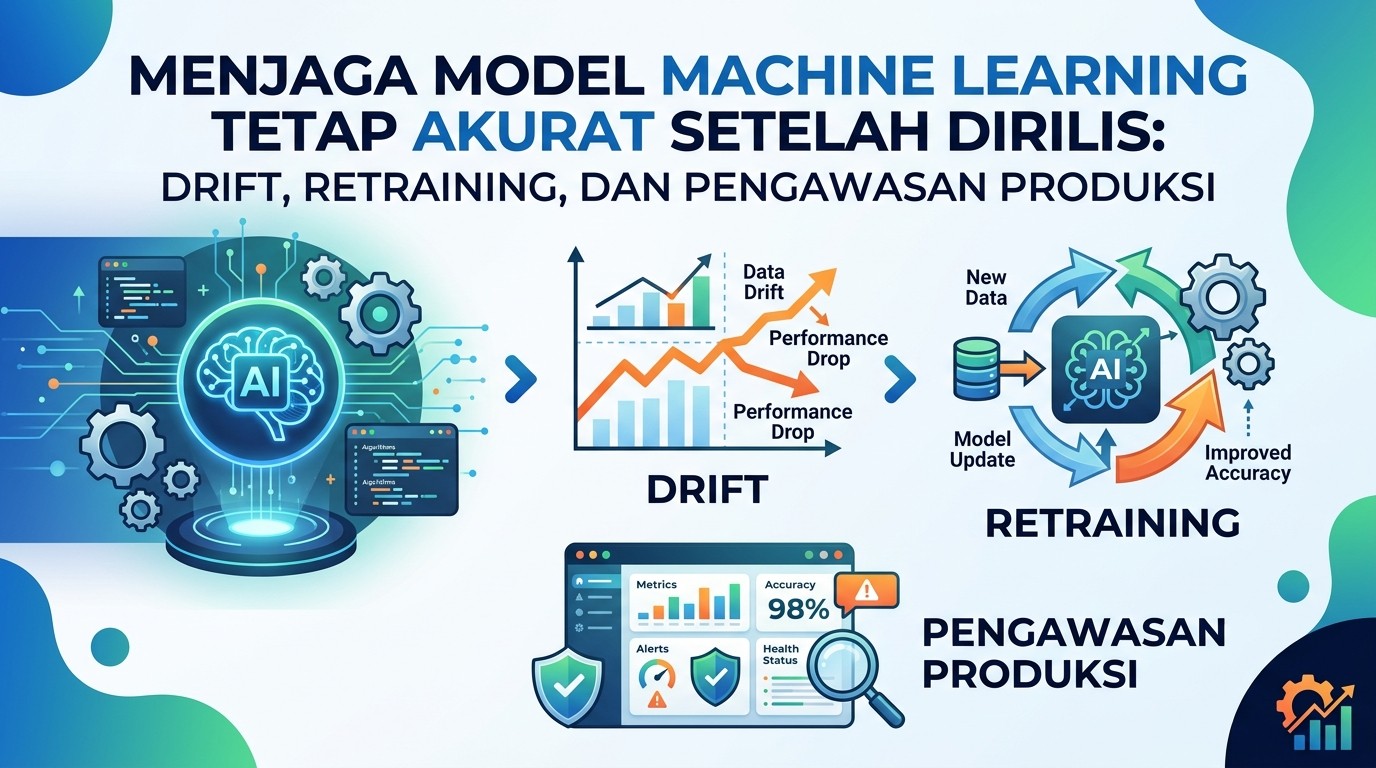
There is an old saying that remains relevant: garbage in, garbage out. No matter how powerful a model is, it will not help if the data is wrong. Healthy practices include checking column consistency, handling missing values, and being wary of data leakage, namely the situation when information from the future unknowingly enters training. To test how robust a model is, techniques such as cross validation are far more honest than a single data split. Also add monitoring of the input data distribution, because the real world keeps shifting and patterns that were once accurate can slowly drift.
Choosing a Model: Simple Often Wins
Not every problem needs a multi-layered neural network. For medium-sized tabular data, models such as logistic regression or combined decision trees often deliver competitive results at much lower training cost and time. Only when dealing with large-volume text, images, or audio do deep learning and transformer models begin to show their superiority. The principle is simple: start with the lightest solution, measure with metrics that match business goals, then increase complexity only if truly necessary. Remember, metrics such as accuracy can be misleading on imbalanced data, so precision, recall, or F1 are often more informative.
MLOps: Keeping the Model Healthy After Release
Releasing a model is the starting point, not the finish line. Once it is running, you need to know whether its predictions still make sense and whether the system is healthy. Some helpful habits include:
- Store model and data versions so that every decision can be traced back.
- Monitor performance periodically and compare it with actual results in the field.
- Prepare a fast rollback path in case a new version turns out to be harmful.
- Automate retraining through scheduled pipelines, rather than relying on human memory.
In this way, machine learning is treated like other software that deserves maintenance, not a one-off project that is later abandoned.
Calculating Costs and Maintaining Efficiency
Compute for training and running models is not free. Large-scale training requires expensive accelerators, while continuously running inference eats into the budget every month. Some practical cost-saving strategies include choosing a proportional model size, utilizing quantization techniques, and running lightweight models directly on edge devices when low latency matters more than extreme accuracy. AutoML and hyperparameter search can also cut experimentation time, as long as they remain controlled so they do not turn into a waste of resources.
Trends You Should Watch
The machine learning landscape keeps moving. Multimodal models capable of processing text, images, and sound at once are becoming more accessible. Approaches that combine information retrieval with large language models help make answers more grounded. In addition, awareness of ethics, transparency, and data protection is increasingly a requirement, not a supplement. For teams just starting out, the wisest step is not to chase the most cutting-edge, but to build a solid data and process foundation first.
ArtonLabs colleagues, thank you for following this discussion to the end. We hope the overview above helps you assess the readiness of your machine learning projects, whether they are being designed or already running. If you have any questions about this topic, do not hesitate to contact us through the contact page.